Saturday, September 25, 2010
Distinguishing the changeable from the fixed
23 September 2010 | by Letters Editor
Fr Thomas Gibson, Kensington, Johannesburg
Regarding Mervyn Pollit’s letter “Church Crisis” (August 18), I would like to share with all The Southern Cross readers my point of view.
1) No doubt we are immersed in a crisis. However, in my Parish I can say that not one practising Catholic with a minimum of formation has left the Church because of this. On the contrary, I would say that it has encouraged them to be more faithful.
2) I realise that if a member of the Catholic Church is able to say that “the laity will no longer allow a handful of clergy in the Vatican to dictate to us”, that person is going through a serious crisis in his belief, probably out of ignorance of what the Catholic Church is.
3) Before we reach Vatican Council III, we need to assimilate and put into practice the teachings of Vatican Council II, especially what Lumen Gentium has taught about the kind of Church our founder (Jesus Christ) wanted: Hierarchy (Pope, bishops, priests, deacons), religious and lay people, each one with his/her specific role.
4) We need to distinguish in the life of the Church those things that are “changeable” from those that are not. No one in the Church, not even Pope Benedict or a Vatican Council III, can change the indissolubility of marriage, the moral teachings regarding contraception or the nowadays frequent issue of the ordination of woman.
May these words of Pope John Paul II illustrate what I am saying: “The Church does not have any power to confer priestly ordination to women. This affirmation should be considered definitive for all the faithful of the Church” (Letter Ordinatio sacerdotalis; May 22, 1994) Why can’t we change these issues? To put it in a simple way, because it’s in the Gospel (explicitly or implicitly).
The discipline of priestly celibacy could be changed, but it would be going backwards (to understand this I recommend reading Paul VI’s Encyclical Letter Sacerdotalis Coelibatus; June 24, 1967).
5) If we look around we see thousands of different Christian denominations. In the origin of this splitting process we always find the rejection of some of these “unchangeable” issues.
The divorce of Henry VIII in the case of the Anglicans is well known by all. That’s why I start worrying when I see people claiming changes that no one in the Church can concede. I cannot avoid thinking that a new split is coming or has already taken place.
The priestly prayer of Jesus at the Last Supper is always actual: “I pray not only for them, but also for those who believe in me because of their message. I pray that they may all be one. Father! May they be in us, just as you are in me and I am in you. May they be one, so that the world will believe that you sent me” (John 17, 20-21)
Sunday, April 25, 2010
Love For the Roman Pontiff Must Be In Us A Delightful Passion
The supreme power of the Roman Pontiff and his infallibility, when he speaks ex cathedra, are not human inventions. They are based on the explicit foundational will of Christ. How foolish it is, then, to confront the government of the Pope with that of the bishops, or to reduce the validity of the pontifical Magisterium to the consent of the faithful! Nothing is more foreign to it than a balance of powers; human moulds of thought do not help us, no matter how attractive or functional they may be. No one in the Church enjoys absolute power by himself, as man. In the Church there is no leader other than Christ. And Christ constituted a vicar of his — the Roman Pontiff — for his wayfaring spouse on earth.
The Church is apostolic by constitution. That which truly is and is called catholic, should stand out at one and the same time by the prerogatives of unity, holiness and apostolic succession. In that way, the Church is one, with a clear and perfect unity of the whole world and all nations, with that unity of which the principle, root and indefectible origin is the supreme authority and most excellent primacy of blessed Peter, prince of the Apostles, and his successors in the Roman See. And there is no other Catholic Church, but that one which, built on the one Peter, rises up on the unity of the faith and on charity in one unique body, joined together and compact.
We help to make that apostolic continuity more evident in the eyes of all men by demonstrating with exquisite fidelity our union with the Pope, which is union with Peter. Love for the Roman Pontiff must be in us a delightful passion, for in him we see Christ. If we deal with the Lord in prayer, we will go forward with a clear gaze that will permit us to perceive the action of the Holy Spirit, even in the face of events we do not understand or which produce sighs or sorrow.
St Josemaría Escrivá, In Love with the Church, Loyalty to the Church, no.13
A Positive Focus
The relentless onslaught on the Pope from every quarter of the MSM seems neverending and one feels completely helpless at times. I have tended lately to pay less and less attention to all of it and to try focusing more on prayer for the Holy Father. One can so easily get caught up in the vortex of negativity to the point where it actually drains you and leaves you sitting in the middle of a negative fog of sorts where you are of no help to anyone, including the Pope. I have decided to limit my exposure to its toxicity and to simply focus on continuing to pray for His Holiness.
I came across an article on the Schoenstatt website this evening, via an email, that I found to be a breath of fresh air in all the negativity surrounding the Holy Father and the sexual abuse scandal. It is a reflection that was the response of the Johannesburg Schoenstatt's Women's League on their last Covenant Day to the sexual abuse scandal and the general negativity that often surrounds so many of our priests. I think it is a beautiful reflection and so very true.
Called to support our Priests
--------------------------------------------------------------------------------
SOUTH AFRICA, Sarah-Leah Pimentel. The Schoenstatt Family in Johannesburg is focusing on priesthood this year, as there are still a few months left to the Year of the Priest and we also celebrate the centenary of Fr. Kentenich's priesthood.In light of the negative media focus on our priests in recent weeks, the following reflection was given as the response of the Women's League on last Covenant Day.
In June last year, the Holy Father declared a Year of the Priest. This year we also celebrate the centenary of the ordination of Fr. Joseph Kentenich, the father and founder of the Schoenstatt Movement.
In light of these two events, we are being called in a special way to support our priests, perhaps even more so now, as the Church as a whole comes to terms with the knowledge of priests who have caused great hurt to individual members of the Church. These men, who are Christ's representatives on earth, have destroyed for many the possibility of a tender and deep relationship with Christ.
As members of the Schoenstatt Women's League in Johannesburg, South Africa, we believe that as laity, there are many ways that we can support our priests and we can offer our support as contributions to the altar of our Lord.
Pray
So often we complain about our priests, about what they have done that they shouldn't have done or the things that they didn't do. We comment on their character flaws to everyone we meet. Perhaps this month, we're called to refrain from this sort of gossip, using our tongues rather to pray for our priests. We can spare one prayer each day for our parish priest and any other priests that have passed through our lives over the years.
What prayers then do our priests need? We can pray for their priesthood - everyday we see the threats to their vocation. We can pray that even though they empty themselves for us, they will also be filled with many gifts and graces. We can pray that each day, they awaken filled with enthusiasm for their mission, strength to face their daily difficulties. We can pray that they, too, can often feel that God hears their prayers.
Praise
We need to publically acknowledge and thank them for the good work that our priests are doing in our communities. Give praise where praise is due, the old saying tells us. How would it be if every opportunity we had we told of some positive experience with a priest. Or of some things we admire about the priests whom we have experienced over the years? Perhaps we could make it a point of thanking our parish priest once a week for something in particular.
Unburden
So often, we only see our priests in Mass but forget that they have other duties. They need to visit the sick, counsel the many who come to them for help, assist the local community, run training and spiritual programs, be responsible for the upkeep of the church and the numerous other tasks in the parish.
Would their work not be easier, if we could relieve them of some of their burdens? No matter how small the task, if each parishioner did one thing to help in the life of the Church, then the parish priest's whole job could become so much easier. Imagine how well a parish would run if the priest had an electrician, plumber or gardener to oversee that tasks in these areas of expertise are completed. Those of us with basic computer and phone answering skills could easily solve half of the admin problems many priests have to contend with. Could not a trustworthy person be given the task of taking collection money to the bank or paying the bills?
So often we think that we are the only person in the parish and that the priest needs to answer my every need. We can help by making appointments to see them at a time that suits them rather than demanding their attention after Mass because this time suits me.
There are many ways in which we can help our priests with the more mundane tasks, leaving them free to continue with their work of ministering to the community.
Get Involved
Before the 2nd Vatican Council, priest and the religious did everything. Thanks to Vatican II, we no longer have an excuse not to get involved in the task of spreading God's word. In 1931, long before the 2nd Vatican Council, Fr Kentenich gave a talk to priests in which he said: "The laity too has a mission; they, too, are incorporated into Christ and Christ wants to fulfill his mission through them also."
Fr. Kentenich understood that as people become increasingly educated, they "have more access to political and spiritual-intellectual power." As such the laity has the ability to equip themselves to do fulfill God's mission here on earth. Fr. Kentenich promoted a strong ‘program' of self-education. This not only equips us to discover a deeper relationship with Christ through our meditation on the Gospels and an active search to understand more fully the teachings of the Church. This self-education also bestows on us a greater responsibility as lay people towards our Church and the community we live in. Fr. Kentenich warns us that "the problems of the Church are made worse because a great many Catholics among us are sleeping" and he therefore urges us to "wake up a religious sense of responsibility is stirred up. Many lay men and women are concerned and worried about the Church."
On that note, each one of us is called to reflect: Which areas of my self-education need work? And how can I use this to assist in the ministry of the Church? Am I called to teaching catechism, running a bible study or prayer group, becoming a minister of Holy Communion or a proclaimer? Does God want to use my skills to organize a soup kitchen to feed the poor of the parish? Is there some other unique task only I am able to do?
Accountability
Finally, we're called to engage with our priests in a mature way. But we need to remember that our priests are also human and can err. In these cases, it is our responsibility to pray for discernment so that the Holy Spirit can guide on how to approach our priests and make them aware of where they have failed their flock and perhaps strayed from the mission that God entrusted to them. Through my example and my relationship with my parish priest, do I strengthen him in living his vocation or do I make it more difficult for him?
On the silver Jubilee of his ordination the priesthood, Fr. Kentenich linked the ‘success' of his vocation to "all those who have linked their lives and destinies...with mine." The sanctity of priesthood, then also partially depends on us. Fr. Kentenich urged us to "interiorly united with one another." This means that, not only are our hearts united to those people with whom we share natural bonds, but we should also unite our hearts to the hearts of our priests - this is how we support them and help them continue to be good priests.
If our hearts are united, this means that we have a common bond that links us and makes us one, makes us a family. In Schoenstatt, this bond is our Covenant of Love and we live out this covenant through our contributions to the Capital of Grace. Fr. Kentenich makes it very clear: in reflecting on his priesthood and his mission of uniting God's people, he says that "these have safeguarded the family by increasing the capital of grace." Similarly, we can help to safeguard the family of the Catholic Church in light of all the challenges it is facing by increasing our contributions to the Capital of Grace.
The Schoenstatt Women's League in Johannesburg invites the Schoenstatt Family to support our priests by offering one practical actions that we can follow up on in our parishes when we leave here today and offer it as a contribution to the Capital of Grace for your parish priest or a priest with whom you have an interior connectedness as Fr. Kentenich mentioned.
And do not feel discouraged that your efforts are futile in light of the mammoth task that faces us and hear Father's words as he encourages us: "Eternity one day will reveal how the smallest and most hidden souls of our family have contributed treasure after treasure. Without their heroic lives of sacrifice and prayer, the family spirit we have today, would be unthinkable. Indeed, nothing without you."
Wednesday, February 3, 2010
Excellent Catholic Resource
"taught for forty years in Catholic Junior and primary schools, daily teaching Religious Education. As a member of the Catholic Evidence Guild, and friend of Frank Sheed and Maisie Ward, she spoke regularly at Speaker’s Corner in Hyde Park. Since retiring, she has worked to protect the Faith inheritance of Catholics in the U.K. by her Chairmanship of Pro Ecclesia et Pontifice, being part of the team responsible for bringing many famous speakers, including Mother Angelica of EWTN, to address the Faith of our Fathers Conferences. Her edifying presentation in these quality recordings is ideally suitable for parents and teachers who are trying to teach children the Faith."
It really is a beautiful series of talks that are presented in a simple, yet beautiful and profound way. You can access the relevant page HERE.
The site also offers free downloads of talks by Bishop Fulton J. Sheen and other equally valuable resources.
Saturday, January 23, 2010
Opus Dei and the Pope's visit to Britain
I work in a parish that is run by the Prelature of Opus Dei. I am not a numerary, supernumerary or a cooperator but I have developed a great respect for the Prelature based simply on the reverence that they have for the Blessed Sacrament and their total obedience to the Holy Father. I have, for just over a year now, attended their monthly Recollections at which one listens to a reading from one of St Josemaria's works (which are excellent, by the way), one is given a meditation by an Opus Dei priest, one is allowed time to make an examination of conscience and is given the opportunity to go to confession and then one listens to a talk on a particular spiritual topic by an Opus Dei numerary. The Recollection then comes to a close with a Benediction of the Blessed Sacrament which I always find quite beautiful. At NO time have I ever been pushed or forced to do anything by anyone in Opus Dei. If you read some of the 'testimonials' of ex-numeraries and supernumeraries you would swear that you are dealing with the Catholic version of 'the Moonies'. All I can say is that if one does come across such things, one should read such them with a great deal of common sense and discernment, especially if you have had no previous contact with Opus Dei. There are also always two sides to a story.
Have people had bad experiences with Opus Dei? Of course, I have no doubt of that. That is simply life. No religious Order or Association is perfect because it is peopled by human beings who are weak and given to error. How many of the saints were badly treated by members of their own order? St John of the Cross, St Margaret Mary and St Faustina are just a few who immediately spring to mind. In the end, no matter which Order they belonged to, their sole (soul?) focus was Christ and not their own particular wants, needs or opinions.
Make no mistake, Opus Dei is totally oriented towards Christ and the Church and I am thoroughly tired of people who call them the "Catholic Mafia" or "fanatics". If being loyal to the Holy See makes you a 'fanatic', then God help Catholicism.
I would like to end with a quote from St Josemaria Escriva's The Forge which I have always found inspiring:
39. I see myself like a poor little bird, accustomed only to making short flights from tree to tree, or, at most, up to a third floor balcony… One day in its life it succeeded in reaching the roof of a modest building, that you could hardly call a skyscraper.
But suddenly our little bird is snatched up by an eagle, who mistakes the bird for one of its own brood. In its powerful talons the bird is borne higher and higher, above the mountains of the earth and the snow—capped peaks, above the white, blue and rose—pink clouds, and higher and higher until it can look right into the sun. And then the eagle lets go of the little bird and says: Off you go. Fly!
—Lord, may I never flutter again close to the ground. May I always be enlightened by the rays of the divine sun — Christ — in the Eucharist. May my flight never be interrupted until I find repose in your Heart.
Friday, January 1, 2010
St Josemaría Escrivá and his love and veneration for the Pope
When Saint Josemaría Escrivá was very young he used to dream of getting close to the Pope even for only a few moments, to have the chance of showing him his love and readiness to serve him. Msgr Javier Echevarría says: “His joy when he was actually in the Pope’s presence was immense. I could see that whenever I went with him to an audience with the Pope.” Msgr Echevarría, now the prelate of Opus Dei himself, witnessed Saint Josemaría’s love for the Pope back in the summer of 1950, at Castel Gandolfo, when they were staying near the Holy Father’s summer residence.
From that period I remember how affectionately he used to talk to us about the Pope. He used to get up enthusiastically to go to the roadside to see Pope Pius XII going past, on his way back from Rome to Castel Gandolfo after the Holy Year audiences. Msgr. Escrivá used to ask us to pray very hard for the Pope and love him very much, and show him our affection, because we ought always to see the Pope as the successor of Saint Peter, the dolce Cristo in terra, the “sweet Christ on earth”. And I saw how devoutly he would receive the blessing which the Holy Father gave from his car as he went by.
Before I went back to Spain Msgr. Escrivá asked me to spend two days in Rome to gain the Jubilee and visit the four Basilicas. He asked me to pray with great faith, especially in Saint Peter’s, feeling very united with the Pope, for the holiness of everyone in the Church to increase, and for more conversions everywhere. He recommended me not to forget my family, and to add my parents’ devotion to my own, since in a way I could represent them, because they would have loved to have the chance to pray in the Eternal City close to the See of Peter.
I very soon saw how continually Saint Josemaría renewed the offering of his life for the Pope, in readiness to give his life at any moment, with the grace of God. And he repeated that offering on the morning of 26 June 1975.
He would repeat, with absolute conviction, the words of Psalm 35:10, Apud Te est fons vitae et in lumine tuo videbimus lumen! (In you is the source of life and in your light we see light). He used this to increase his unity with Christ’s Vicar on earth. He always firmly believed that his union with the Blessed Trinity would grow still closer, the closer he was united in mind and will to the Pope and his intentions.
On countless occasions I heard him use expressions like “the common Father” or “the house of the common Father”, referring to the Pope or the Apostolic See. These expressions helped him experience the catholicity of the Church. He was made deeply happy by whatever made the Pope happy, and he likewise suffered when the Pope was suffering.
While on this subject, I remember how in October 1958, as soon as he heard that Pope Pius XII was gravely ill, he followed all the official communiqués closely. (…) It was the same when Pope John XXIII was seriously ill. I saw in his face how much he was suffering as he told us what Msgr. Dell’Acqua had said to him. Msgr Escrivá’s heart poured out words and expressions, even sighs, that showed how he was accompanying the common Father, how affected he was by the Pope’s sufferings.
I should make it clear that Msgr Escrivá never got edgy. But when he was in the presence of the Holy Father he was genuinely moved, and he never tried to hide or to overcome that sensation. And he was also delighted when he got permission for me, as secretary, to go and greet the Pope, the Successor of Peter. He always told me the same thing: “Fall on your knees, and make the most of those moments to show your love and veneration, and to increase your prayer for and union with the Pope, the Vicar of Christ.”
Extracts from: Echevarría, Javier y Bernal, Salvador, Memoria del Beato Josemaría Escrivá, Madrid, Rialp, 2000 (1st edition).
Friday, December 25, 2009
Was someone asleep on their feet?
It also disturbs me that some commentators seem to be at pains to somehow exonerate the woman saying that she meant no real harm and that such people seldom do. To me that is not the issue. It doesn't matter who she is or what her real intent was. The fact is that she got close enough to the Holy Father to do some serious damage.
Given that the Holy Father was pulled down so quickly and so violently we can only thank God that he did not sustain any serious injuries. It continues to be unclear as to how exactly poor Cardinal Etchegaray was knocked over and reports differ as to whether he has fractured his femur or his hip. At 87 this is not a joke and we can only pray that, God willing, he will make a full recovery. Let us pray too that this disturbed woman may also find some sort of peace and healing.
Sunday, December 13, 2009
Gaudete Sunday
Gaudete Sunday corresponds to Laetare Sunday during Lent. These Sundays allow us a glimpse of the joy and light which await us in the Incarnation and Resurrection of Jesus. Advent, like Lent, is a penitential season, something which is so often forgotten amidst the materialism, consumerism and man-made ‘happiness’ that surround us at this time of year. Whilst the ‘advent’ or coming of our Lord is a cause for celebration and joy, the light of our Saviour’s incarnation is dimmed for us if we are not adequately prepared for His coming. In order to prepare, we must examine ourselves closely and acknowledge those areas of our lives which are a barrier to our full communion with Christ.
In the Catechism of the Catholic Church we find the following regarding Advent:
“When the Church celebrates the liturgy of Advent each year, she makes present this ancient expectancy of the Messiah, for by sharing in the long preparation for the Saviour's first coming, the faithful renew their ardent desire for his second coming. By celebrating the precursor's birth and martyrdom, the Church unites herself to his desire.” "He must increase, but I must decrease." (CCC 524)
We must decrease, through humility, so that we may be filled with His light and goodness. We become Christ-like when we acknowledge and seek forgiveness in the Sacrament of Reconciliation for those thoughts and actions which separate us from Him. It is not He who separates us from Him but we ourselves who willfully turn away from Him through selfishness and pride.
In this light, consider the following brief examination of conscience:
Do I ignore God or exclude him from my life?
Have I used God’s name in anger or carelessly?
Have I received Holy Communion in a state of mortal sin?
Have I been impatient, angry or jealous?
Have I been lazy at my work or at home?
Have I been uncharitable or unkind in thought, word or deed?
Have I told lies?
Do I judge others unfairly?
This is a time during which we should use every opportunity to turn towards Christ, to convert fully and receive, with joyful and humble expectation, Christ’s light and grace within our souls.
Gaudete! Rejoice!
Tuesday, December 8, 2009
Another Priest Murdered in South Africa
From the news24 website:
Pretoria - Father Louis Blondel, 70, a French priest of the Sacred Heart Catholic Church in Diepsloot, north of Johannesburg, was shot dead in his room on Monday at about 02:00 when child robbers gained access to the rectory.The rest of this thoroughly unpleasant story can be read here.
Blondel is the fourth Catholic priest to be murdered in South Africa this year.
He was shot through his left shoulder, with the bullet exiting his back. The children had opened the door for the robber.
Blondel had been a member of the Missionaries of Africa, whose stated mission is serving the people of Africa. He's been in South Africa since 1987 and has lived in Diepsloot since August last year.
Before moving there, he worked in Tanzania, Soweto and Hammanskraal, north of Pretoria. Father Guido Bourgeois, 70, who saw Blondel being shot, said three teenagers entered the house through a window at approximately 02:00.
"They came into my room and woke me. I started to scream but they told me to 'shut up'. One of them was pointing something in my direction, but I couldn't see if it was a firearm," said Bourgeois.
Looked for money
The children asked for money, upon which he gave them a R50 note he had in his wallet.
"One of them removed a painting from the wall to see if there's a safe behind it. The other opened cupboards and said they're looking for money."
According to Bourgeois, the teenagers asked for keys to the house. They followed him to the front door, where they forced him to unlock it.
"When I unlocked the door, a big, tall man of about 35 years was standing in front of me."
Bourgeois said the robbers then forced him back into the house and wanted to know how many people there were in the house. He said there were three.
The other resident is a man who had been staying there for a few months, since he had no other place to stay.
The worst of it is that very little was taken. I believe that Fr Bourgeois gave them his cellphone in addition to the R50 (approx $6 or £4). The unfortunate fact is that many people seem to think that the Catholic Church and its priests are positively rolling in money. We have had two burglaries this year in our Parish and a couple of rather unpleasant incidents in which people with unpleasant motives have gained access to the rectory under false pretenses. One can no longer simply allow anyone unknown into the rectory anymore, even if they simply request to see the priest. They stay firmly outside on the other side of the security gate until their reason for being on our doorstep has been firmly established. This, of course, does not apply to people who are known to the Parish. Luckily no one was injured in the abovementioned incidents. However, it is certainly not pleasant to have to treat people in this way but it has, unfortunately, become very necessary.
Please say a prayer for Fr Blondel and for the Missionaries of Africa who do so much good work in the Diepsloot community and elsewhere.
Sunday, March 8, 2009
Father Lionel Sham R.I.P
From the website of our local newspaper, The Star:
One nabbed for missing priest
The body of a priest who had gone missing earlier this week has been found, the Southern African Catholic Bishops' Conference said on Sunday.
"Archbishop Buti Tlhagale, Catholic Archbishop of Johannesburg, regrets to announce that the SAPS have found the Body of Fr Lionel Sham.
Sham, the parish priest of Mohlakeng had been missing since Friday afternoon.
Police had recovered his missing car at an accident scene in Denysville in the Free State on Sunday morning.
Captain Joseph Magoai said a man was arrested after Sham's car was recovered.
Magoai said police had been alerted on Saturday that Sham was missing.
"We received information that he was missing and some household items were missing," said Magoai.
SACBC spokesperson Father Chris Townsend said when Sham went missing on Friday, "there were signs of struggle in his presbytery and household and parish items and the parish car are missing.
"Townsend said Sham had been a "friend and mentor" to many."
He had worked at Boys Town, in various parish assignments, as administrator of the Cathedral of Christ the King in Johannesburg, Rector of the Orientation Seminary in Welkom, Secretary of the Seminary Department of the Bishops Conference, Vocation Director and Vicar General.
"All we can do now is pray with the family, the parish of Mohlakeng and the many people who loved and knew Lionel," said Archbishop Tlhagale. - Sapa
Please pray for Father Lionel Sham
Please hold this priest in your prayers.
Tuesday, February 10, 2009
A request for a novena to St Therese

Sunday, February 8, 2009
Support the Holy Father in Prayer and in Thought
Although I'm not trying to sweep aside the larger implications of what has happened, I cannot understand why anyone is paying so much attention to Williamson. A good friend of mine, who has been and is still currently heavily involved with SSPX, informed me the other night that he is regarded, even in SSPX circles, as being as nutty as a fruitcake. It certainly gives me the creeps when he allows someone to post photographs of ordinations in Argentina, on his blog, under the title "His Excellency ordains in Argentina, December 2008". I think that tells us all we need to know ....
Sadly, these facts are being disregarded by the MSM and anyone who has a bone to pick with the Holy Father and the Holy See. The wolves are indeed beginning to circle. In this light I would ask all who visit this blog to go to bloggingLOURDES where Father Byers has set up a prayer initiative for the Holy Father. There is also a letter of support that can be signed at Support Pope Benedict XVI.
V: Oremus pro Pontifice nostro Benedicto.
R: Dominus conservet eum, et vivificet eum, et beatum faciat eum in terra, et non tradat eum in animam inimicorum eius.
V: Fiat manus tua super virum dexterae tuae
R: Et super filium hominis quem confirmasti tibi
Oremus. Deus, ómnium fidélium pastor et rector, fámulum tuum Benedíctum, quem pastórem Ecclésiæ tuæ præésse voluísti, propítius réspice: da ei, quæesumus, verbo et exémplo, quibus præest, profícere: ut ad vitam, una cum grege sibi crédito, pervéniat sempitérnam. Per Christum, Dóminum nostrum. Amen.
V: Let us pray for our Pope Benedict.
R: May the Lord preserve him, and give him life, and make him blessed upon the earth, and deliver him not up to the will of his enemies.
V: May Thy hand be ever upon the man of Thy right hand.
R: And upon the son of man whom Thou hast confirmed unto thee.
Let us Pray. O God, Shepherd and Ruler of all Thy faithful people, look mercifully upon Thy servant Benedict, whom Thou hast chosen as shepherd to preside over Thy Church. Grant him, we beseech Thee, that by his word and example, he may edify those over whom he hath charge, so that together with the flock committed to him, may he attain everlasting life. Through Christ our Lord. Amen.
Friday, January 30, 2009
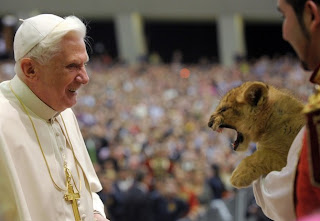
A tiny lion for a lion-hearted Pope
Photo:AP/OR
Here is a link to a video of the circus performance. The lion cub appears about three quarters of the way through. Keep a look out towards the end when the Holy Father actually waves to the lion cub as it is taken away which, for me, was something of a 'lump in the throat' moment.
Monday, December 29, 2008
A Light in the Darkness
I also continue, on a daily basis, to thank God for the presence and grace of His Holiness, Pope Benedict XVI, in our lives. It has been a very dark period with regard to my Faith, but also a time of great Light. This has been due, in a large part, to the gentle wisdom and guidance of our Holy Father. His words are always a true guide and inspiration in these times of continual upheaval, both personally and globally.
Some weeks ago I read the following from the Holy Father’s book, God is Near Us. I had come across this passage quite by coincidence, as I was flicking through the pages, but they would become even more relevant later, as I will explain:
One evening, during the following week, I had a rather unpleasant experience. An experience which I have had only once before. A feeling of being, internally, in total darkness. My previous experience had been nightmarish but, at that moment, I recalled what I had read the previous week and I felt a deep sense of comfort. A deep sense that that moment was a gift. It was only in that darkness that I could see the Light, that I could truly sense something of my own smallness but that I was nevertheless being held by an strong and incomprehensible Love, one that we can simply not match with our own efforts.“Even when Abraham was still on his way, and as yet knew nothing of the mystery of the ram, he was able to say to Isaac, with trust in his heart: Deus providebit – God will take care of us. Because he knew this God, therefore, even in the dark night of his incomprehension he knew that he is a loving God, therefore, even then, when he found he could understand nothing, he could put his trust in him and could know that the very one that seemed to be oppressing him truly loved him even then. Only in thus going onward, so that his heart was opened up, so that he entered the abyss of trust and, in the dark night of the uncomprehended God, dared keep company with him, did he thereby become capable of accepting the ram, of understanding the God who gives to us that we may give. This Abraham, in any case, has something to say to all of us. If we are only looking on from outside, if we only let God’s action wash over us from without and only insofar as it is directed toward us, then we will soon come to see God as a tyrant who plays about with the world. But the more we keep him company, the more we trust in him in the dark night of the uncomprehended God, the more we will become aware that the very God who seems to be tormenting us is the one who truly loves us, the one we can trust without reserve. The deeper we go down into the dark night of the uncomprehended God and trust in him, the more we will discover him and will find the love and the freedom that will carry us through any and every night. God gives that we may give. This is the essence of the Eucharistic Sacrifice, of the sacrifice of Jesus Christ; from the earliest times, the Roman Canon has expressed it thus: “De tuis donis ac datis offerimus tibi” – from your gifts and offerings we offer you.” (p.46-47)
“It is easier to love someone that you know, than to love someone you don’t know.” These particular words from Father Thomas’s Christmas Mass homily, with reference to our love of Christ, the need to make an effort to come to know Him and love Him more intimately, continue to resonate in my mind. It led me to reflect on my own lack of love for Our Lord. On how much easier it is to allow the distractions of the material world to overwhelm us and trick us into thinking that it alone can sustain us. I find that one sure source of coming to know Christ more intimately, is the through the words of the Holy Father. I found his meditation on the Liturgy of Hours during the opening of the 12th General Synod of Bishops to be particularly moving. The meditation as a whole, touched me deeply, as so many of his words of the Holy Father often do. However, during a rereading of this meditation this afternoon, these words moved me:
“Therefore, exegesis, the true reading of Holy Scripture, is not only a literary phenomenon, not only reading a text. It is the movement of my existence. It ismoving towards the Word of God in the human words. Only by conforming ourselves to the Mystery of God, to the Lord who is the Word, can we enter within the Word, can we truly find the Word of God in human words. Let us pray to the Lord that he may help us search the word, not only with our intellect but also with our entire existence.”I see in his own words, that movement towards God in human words. Strangely, these ‘words’ connect with something else that Father Thomas said regarding Scripture during his Christmas homily. He recounted how he often people tell him how wonderful a certain movie is. How, for example, they have seen it ten times. His response to this was to say how marvelous it would be if we were to devote this amount of enthusiasm to reading the Gospels. To read a passage from the Gospel ten times. How right he is! I myself am overtly fond of rewatching particular scenes from certain movies. It is only through that sort of immersion in Scripture that I will indeed be able to search the Word, with my entire existence.
May the Lord protect and sustain our Holy Father so that he might continue to be a light and guide for all of us within the encroaching darkness.
Wednesday, December 17, 2008
Receiving Communion
30 November 2008
Dear parishioners:
As I was saying last Sunday, and many of you probably knew, since the Feast of Corpus Christi this year, Pope Benedict XVI has only distributed communion on the tongue to communicants that are kneeling. At
first some thought that this was only a "once off', but the Holy Father has continued with this practice. Why is he doing this and what is the practical teaching that he wants to give us?
After Pope Benedict XVI started distributing the Holy Communion this way, Msgr. Guido Marini, the Master of Papal Liturgical Ceremonies, in an interview that appeared in L'Osservatore Romano (25/6/2008)
was asked if this practice is destined to become habitual in papal celebrations.
This was his answer:
"I really believe so. In this regard it must not be forgotten that the
distribution of Communion in the hand still remains, from the juridical
standpoint, an exception to the universal law, conceded by the Holy See to those
bishops' conferences that have asked for it. The form adopted by Benedict XVI is
meant to underscore the force of the norm valid for the entire Church.
Furthermore, one might also note a preference for the use of this method of
distribution which, without taking anything from the other,
better highlights the truth of the real presence in the Eucharist, fosters the
devotion of the faithful and more readily introduces them to the sense of
mystery."
To understand why Msgr. Marini says that Communion in the hand still remains, from the juridical
standpoint, an exception to the universal law, you have to know a bit of the history of this change in the practice of the Church.
It will come as a surprise especially to younger Catholics that the modern practice of receiving communion in the hand dates back only about forty years. In the years following the Second Vatican council a few countries began experimenting with "communion in the hand", This was done without asking the permission from the Holy See. To legalize this irregular situation a few bishops and bishops conferences asked for permission to distribute communion in the hand.
Pope Paul VI then asked the bishops of the world for their opinion. The vast majority voted against the distribution of communion in the hand. 1,233 said No and 597 Yes.
In line with the views of the bishops in 1969 the Congregation for Divine Worship issued a document "Memoriale Domini" (approved by Pope Paul VI after suggesting several changes in the text. This document can be read at http://www.ewtn.com/library/CURIA/CDWMEMOR.HTM). It strongly supported and
encouraged the reception of communion on the tongue to a kneeling communicant.
In this document the Holy See makes it clear that "This method of distributing holy communion [on the tongue and kneeling] must be retained, taking the present situation of the Church in the entire world into account."
Below are some of the reasons that the Holy See gives:
Reverence for the Eucharist.
This traditional method of receiving is preferable not just because "it has many centuries of tradition behind it, but especially because it expresses the faithful's reverence for the Eucharist."
Part of the preparation to receive communion
Some have argued that having to kneel to receive communion and to be fed the Host is belittling. The Holy See responds to this by emphasising that "the custom does not detract in any way from the personal dignity of those who approach this great sacrament: it is part of that preparation that is needed for the most fruitful reception of the Body ofthe Lord." By kneeling we prepare ourselves for communion showing that we approach this great sacrament in a spirit humility and awe.
By receiving the Host in this reverent manner, so different from the way we would receive normal food, we show 'that it is not a sharing in "ordinary bread and wine" that is involved, but in the Body and Blood ofthe Lord'.
Removes the danger of profanation
This traditional practice "ensures, more effectively, that holy communion is distributed with the proper respect, decorum and dignity. It removes the danger of profanation of the sacred species, in which "in a unique way, Christ, God and man, is present whole and entire, substantially and continually."
Respect for the smallest part of the Host
"Lastly, it ensures that diligent carefulness about the fragments of consecrated bread which the Church has always recommended: It What you haveallowed to drop, think of it as though you had lost one of your own
members."
At the end of Memoriale Domini the Holy See set out the following procedure which is to be observed:
" Where a contrary usage, that of placing holy communion on the hand, prevails,( ... ) In such cases, Episcopal conferences should examine matters carefully and should make whatever decisions, by a secret vote and with two-thirds majority, are needed to regulate matters. Their decisions should be sent to Rome to receive the necessary confirmation, accompanied with a detailed account of the reasons which led them to take those decisions." This explains why Msgr Marini says that communion on the hand is an exception to the general rule and why the Pope is pushing the traditional form.
(All Quotes are from Memoriale Domini)
Over the years the new practice of communion in the hand grew but without many of the faithful realising what they were leaving behind.
So after forty years what are the norms that regulate this issue? You will find the norms for South Africa, set by the Southern African Catholic Bishops' Conference (SACBC), in the Pastoral Introduction to the Order
of the Mass (approved by the SACBC) pp. 81-82 . Norms that obviously are in agreement with the general norms given by the Holy See:
1. "In the Conference area under the jurisdiction of the SACBC, Holy Communion may be received in the hand as well as on the tongue; the choice is the prerogative of the communicant". (This means that the priest or minister has to respect the choice of the communicant, no one has the right to oblige doing it in a certain way).
2. "The norm for the posture of reception of Holy Communion in the dioceses of the SACBC territory is standing. However, communicants who wish to kneel are welcome to do so".
3. "When receiving Holy Communion standing, the communicant may bow the head before the sacrament as a gesture of reverence and receive the Body of the Lord from the minister. The communicant may also use the gesture of "ukuphaphatha" were the hands are gently clapped together in acknowledgement of the gift about to be received. Other signs which are apt are the sign of the cross or genuflection".
As you can see, we are not facing a dogmatic issue. It is something that, as things are now, depends on our choice or preference. There can be no doubt that Pope Benedict XVI, by his courageous liturgical initiative, is sending a strong message to his brother bishops, priests and laity as to the manner in which he would like to see Holy Communion distributed and received at all Masses.
Personally, as you can guess, I am in complete agreement with Pope Benedict XVI in his preference for this traditional way of receiving Holy Communion. I think it's my duty as Parish Priest to share with you this knowledge so you are in a better position to choose. There is a tremendous ignorance regarding this and other liturgical issues, even among us priests. Not long ago a young priest said to me that Communion in the hand was a norm established by the Vatican Council (sic).
As Jesus said: "you will know the truth, and the truth will set you free" (John 8,32).
As I already announced last Sunday, we are going to leave a kneeler in the central corridor when distributing Holy Communion for those communicants who, in use of the right they have, prefer to receive it in the mouth and kneeling. And of course the choice of those who prefer to receive the Communion in the hand will be respected as we have always done.
Please do not hesitate to raise any doubts or issues. In the last weeks I have already received several questions about liturgy: why do we do this, why don't we do that which is common practice in other parishes? I am available and very happy to answer as far as I can any questions you might have.
May God bless you and your families. Please remember me in your prayers.
Yours sincerely
Father Thomas
Tuesday, December 2, 2008
First Tridentine Mass celebrated at Johannesburg Cathedral
As you can see from the photo below, these are very small beginnings but this was a hugely historic occasion. I apologise for the smallness of the image, but the photo came out rather blurry. Fortunately it does not look quite so fuzzy when made a little smaller. There was an official photographer there as well so I will, hopefully, be able to post much better photographs at a later date, although I am sure they will appear elsewhere first.
Father von Lillienfeld celebrates the first official Tridentine Mass in Johannesburg
Sunday, November 23, 2008
Baby steps ....
At today's Mass for the Feast of Christ the King, a number of children in the parish received their First Holy Communion. Something completely unexpected and rather wonderful happened. Our parish priest, Father Thomas, used this opportunity to reintroduce kneelers for those who want to receive communion kneeling.He cited the feast of Corpus Christi during which Pope Benedict first distributed communion to the faithful whilst they were kneeling and on the tongue and that Monsignor Marini had subsequently indicated that this was to become the norm at Papal masses, which has since proved to be correct. Father Thomas also asked people to reflect on the fact that particles of the Host can easily be transferred to the hand and that reception on the tongue was preferable in order to prevent this from happening. He also noted that the reception of communion in the hand was an exception, rather than the rule. From now on we will be able to kneel to receive communion. The choice, however, remains with the individual. Nevertheless, this is definitely a Father Z 'brick by brick' moment.
This may not seem to be particularly exciting news to most people, but I have never had the opportunity, before now, to receive communion kneeling. Thank you Holy Father and thank you Father Thomas.
Speaking of Corpus Christi again brought to mind our Corpus Christi procession earlier this year and I thought it might be a good idea to post a few pictures. Corpus Christi processions like this are, on the whole, rare in South Africa.
The re-entry of the Blessed Sacrament through the church gates
Although we had only just entered winter it was a bitterly cold and rainy day. We processed to a park about a kilometre down the road where Father Manuel, another of the priests who serves at our parish, gave a Benediction. Another Benediction was given in the church on our return for those who could not participate in the procession. The amazing thing was that the rain held off for most of the procession and only started to really come down again when we returned.Sunday, November 9, 2008
Feast of the Dedication of the Basilica of St John Lateran
This basilica is the oldest of the basilicas in Rome, having been dedicated by Pope Sylvester I in 324. It is only when the age of the original basilica is brought to your attention that you begin to realise the true 'age' of our faith and to feel, within one's soul, a gentle but ancient stirring. The deep, but light touch, of all those souls, living and dead, who make up the Communion of Saints.
I finish off, once more, with the words of St Josemaria Escriva from his work, The Forge:
You must love, venerate, pray and mortify yourself for the Pope, and do so with greater affection each day. He is the foundation stone of the Church and, throughout the centuries, right to the end of time, he carries out among men that task of sanctifying and governing which Jesus entrusted to Peter.
Sunday, November 2, 2008
Setting out into the deep in support of the Holy Father
It worries me greatly that many people seem to consider this sort of spiritual support only when there is a condition of some sort attached to it. I've seen too many suggestions, mainly from those who want the universal return of the TLM, that we pray for the Holy Father in order that he does X, Y and Z, usually in relation to the Motu Proprio. I find this behaviour rather ungrateful. A little like throwing a beautiful gift back in the face of the giver or a little like saying to the gift giver "Is this all you bought me?".
Yes, I do understand the frustration, anger and hurt I have seen from many people regarding the suppression of the TLM by their local dioceses and parishes and the fear of those who have only ever known the Novus Ordo. However, the impatience, divisions and vicious debate that one encounters (from both sides of the spectrum), both on the internet, and elsewhere, leads me to believe that there is something other than the Holy Spirit at work amongst the lay faithful and religious with regard to this matter. This is why I feel that we should all look to the Holy Father as our guide in this matter and stop trying to take matters into our own hands. This goes as much for those intransigents who do everything in their power to prevent the celebration of the TLM in their parishes as it does for those who wish to see the immediate abolition of the Novus Ordo Mass.
There is no doubt in my mind, whatsover, that our Holy Father is fully open to the gentle promptings of the Holy Spirit and that he will do whatever is necessary for the wellbeing of the Church.
To quote St Josemaria Escriva:
Your deepest love, your greatest esteem, your most heartfelt veneration, your most complete obedience and your warmest affection have also to be shown towards the Vicar of Christ on earth, towards the Pope.We Catholics should consider that after God and the most Blessed Virgin, our Mother, the Holy Father comes next in the hierarchy of love and authority.